
The Feynman Technique: Learn Hard Topics by Teaching Them to a Child
The Feynman Technique is a powerful method for mastering difficult concepts by teaching them in simple terms. Named after Nobel-winning physicist Richard Feynman, this technique emphasizes breaking down complex ideas into bite-sized, easy-to-understand explanations. In this article, we’ll explore how applying this technique can boost learning and retention, and why teaching others is one of the best ways to learn.
🧠 What is the Feynman Technique?
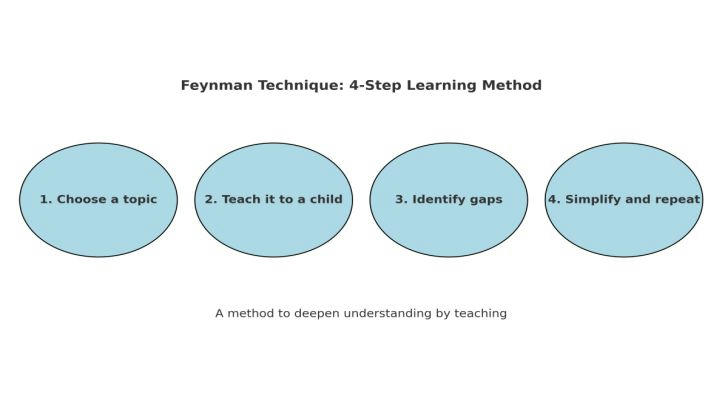
At its core, the Feynman Technique involves four key steps that help simplify complex topics:
- Choose a Concept: Pick a topic you want to understand.
- Teach It to a Child: Explain the concept in simple terms, as if teaching a child.
- Identify Gaps: Find areas where your explanation is unclear or incomplete.
- Review and Simplify: Go back to the source material, fill in the gaps, and simplify the explanation further.
By following these steps, individuals can transform hard-to-grasp concepts into something that is easier to digest and retain.
🔍 Why Teaching a Child Works
The essence of the Feynman Technique is the idea that if you can’t explain something simply, you don’t understand it fully. But why does teaching a child work so well?
- Simplifies Complex Ideas: Explaining difficult concepts forces you to use basic language, which helps strip away unnecessary jargon.
- Active Learning: Teaching requires active engagement with the material, rather than passive reading or note-taking.
- Clarifies Understanding: When forced to break something down to its simplest form, gaps in understanding often become more apparent.
This approach not only improves comprehension but also strengthens long-term retention.
📈 How Effective is the Feynman Technique?
Research suggests that teaching others is one of the most effective ways to reinforce learning. A study published by the Journal of Educational Psychology found that students who taught material to others showed better understanding and recall compared to those who only studied passively.
| Study Group | Method | Outcome |
|---|---|---|
| Passive Learners | Studying alone | 30% recall improvement |
| Active Teachers | Teaching peers | 50% recall improvement |
This demonstrates the value of active learning strategies like the Feynman Technique.

🛠️ Applying the Feynman Technique to Your Studies
To put the Feynman Technique into practice, follow these steps:
- Choose Your Topic: Select a challenging subject—whether it’s a science concept, a math problem, or a historical event.
- Write Down Your Explanation: Pretend you’re teaching the concept to a young child. Write out the explanation using simple language and analogies.
- Identify Weak Areas: As you explain, look for areas where your explanation feels unclear or incomplete. These gaps indicate areas that need more focus.
- Review and Clarify: Return to your study materials, fill in the gaps, and refine your explanation.
By doing this, you’ll not only better understand the material but also improve your ability to recall and apply it.
💡 Example: Explaining Gravity
Let’s say you’re learning about gravity. A simple, child-friendly explanation might go something like this:
“Gravity is like an invisible force that pulls things down. Imagine you’re holding an apple. When you let go, the apple falls because gravity pulls it toward the ground. Everything on Earth is pulled by gravity, and it’s the reason things fall when dropped.”
However, as you dig deeper, you might realize that this explanation doesn’t address the full complexity of gravity, such as how it works in space or how mass influences gravity. Returning to the material and filling in those gaps will deepen your understanding.
🧑🏫 The Role of Simplification in Learning
Simplifying complex ideas doesn’t mean dumbing them down. In fact, it often requires a deeper understanding. Here’s why:
- Clarifies Core Concepts: Focusing on the most basic principles helps you understand the "big picture."
- Forces Precision: Simplification requires choosing the most accurate and concise language to explain an idea, which leads to clearer thinking.
- Identifies Confusion: If something doesn’t make sense when you try to explain it simply, it’s likely that there’s a fundamental misunderstanding that needs to be addressed.
This is one reason why the Feynman Technique is so effective: it encourages learners to focus on the essence of a topic.
📅 Using the Feynman Technique for Exam Preparation
The Feynman Technique can also be an effective tool for preparing for exams. Here’s how to apply it in a study session:
- Start Early: Before your exam, review each topic and write a simple explanation.
- Test Yourself: Attempt to teach each topic to someone else (or pretend to). This reveals weak spots in your understanding.
- Fill in the Gaps: Go back to your notes or textbooks, revisit the areas where you struggled, and revise your explanations.
- Teach Again: Once you feel more confident, teach the material again. The repetition reinforces the knowledge.
This process not only helps with memorization but also improves understanding, making it easier to apply concepts in exam questions.
🌱 Real-Life Example: Feynman in Action
Richard Feynman himself was known for using this technique. He often made complex topics understandable by teaching them in simple, relatable ways. For example, he explained quantum mechanics in a way that even children could understand, using everyday analogies to make abstract concepts more tangible.
This approach wasn’t just about simplifying for simplicity’s sake—it was a tool for deepening his own understanding and mastery of subjects.
🎯 The Benefits of Teaching for Retention
Teaching is one of the most powerful ways to reinforce learning. By explaining material to others, you’re not just memorizing facts—you’re making connections, identifying weak spots, and reinforcing your knowledge.
Studies show that teaching others can improve your retention by up to 50%. This is why many teachers, tutors, and even students in study groups find that explaining concepts helps them grasp the material more thoroughly.
🏁 Conclusion: Mastering Complex Topics with the Feynman Technique
The Feynman Technique is a highly effective method for mastering difficult concepts by teaching them in simple, understandable terms. Whether you’re tackling a challenging academic subject or trying to grasp a complex idea at work, this technique can help clarify your understanding and improve long-term retention.
By following the simple steps—choosing a topic, teaching it like you're explaining it to a child, identifying gaps, and revising your explanation—anyone can enhance their learning process. And remember, as Richard Feynman famously said, "If you can't explain it simply, you don’t understand it well enough." By teaching, you'll not only gain a better grasp of the material but also help others do the same. 😊