
Switching From LPN to RN: Is the Salary Jump Worth the Debt?
Choosing to move from Licensed Practical Nurse (LPN) to Registered Nurse (RN) often involves balancing time, tuition, and career goals. This article lays out evidence, real-world data, and a decision process to judge whether pursuing RN credentials makes sense for a particular situation. 🩺📊

Landscape: workforce demand and openings
Registered nurse employment outlook is positive; projections show growth and many openings in coming years.
LPN/LVN employment growth is steadier but shows fewer openings relative to RN demand.
These labor dynamics mean RN credentials increase opportunities across more clinical settings and roles. Third-party workforce reports confirm ongoing demand for RNs.
Table: employment and educational cost context (real data)
| Indicator | Figure / Note |
|---|---|
| RN projected openings per year | ~189,100 openings annually (2024–2034 projection). |
| LPN projected openings per year | ~54,400 openings annually (2024–2034 projection). |
| Median graduate nursing debt (indicative) | Reported ranges show many graduate nurses anticipate moderate five-figure debt levels. |
Analysis: RN demand is broader, and education costs vary widely. Data above help frame supply-and-demand factors, not a promise about individual outcomes.
Third-party validation and critical lens
Academic and professional bodies document both the need for RNs and typical student-debt experiences.
Critically, averages mask large regional and program-level variation in tuition, living costs, and program length. Decisions should use local program data rather than national averages.
Factors to weigh beyond a simple pay comparison
Program length and scheduling: Part-time bridge programs may lengthen the time until credentialing.
Clinical placement requirements: Hands-on clinical hours affect weekly availability and income during studies.
Licensure exam readiness: Success on the RN licensure exam depends on program quality and individual preparation.
Career trajectory: RNs may access broader practice settings and further education paths.

Typical cost components for LPN→RN pathways
Tuition and mandatory fees for the chosen program type.
Supplies, testing, and board/licensure fees.
Potential lost earnings during study if hours are reduced.
These elements shape the total investment and should be tabulated for any personal calculation.
A practical decision process (step-by-step)
List program options locally with duration and tuition estimates.
Calculate total direct costs: tuition + fees + predictable supplies.
Estimate indirect costs: lost wages or extra childcare during clinicals.
Compare shorter vs longer pathways by time-to-licensure and scheduling fit.
Run scenarios: conservative, moderate, and optimistic timelines for finishing and employment.
This structured exercise reveals sensitivities—small differences in program length or clinical scheduling often change the calculus.
Case example: Maria’s bridge decision
Maria is an LPN with years of practical experience. Local bridge programs ranged from accelerated to part-time evening formats. Tuition estimates differed substantially.
Maria mapped out direct and indirect costs, then piloted a work-study schedule to see if juggling both was feasible. Clinical scheduling constraints ultimately guided the chosen program.
Outcome: Maria selected a program aligned with steady progress and manageable work hours, preserving income while completing studies.
Debt considerations and repayment realities
Nursing-related education debt varies; some graduate-level reports indicate many students hold moderate five-figure balances.
Loan repayment depends on the loan type, repayment plan chosen, and future income—avoid assuming a one-size timeline. Critical evaluation of repayment scenarios is essential before committing.
Policy and employer supports to explore
Employer tuition assistance, loan repayment programs, and hospital-based residencies sometimes reduce net cost; verify specific program terms.
State and federal programs may offer support for practice in underserved areas; eligibility rules and commitments vary widely and require careful review.
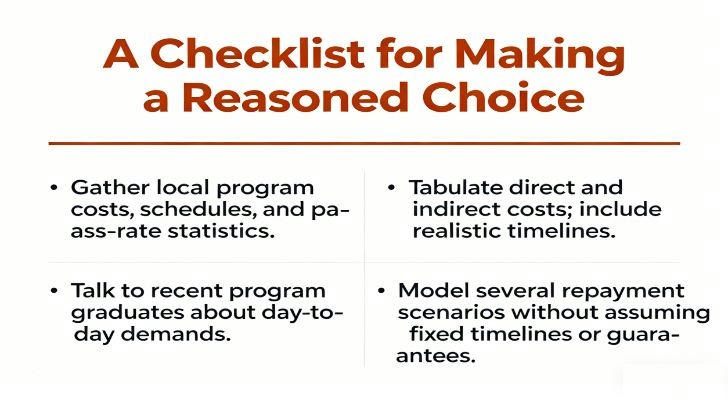
Checklist: making a reasoned choice ✅
Gather local program costs, schedules, and pass-rate statistics.
Tabulate direct and indirect costs; include realistic timelines.
Talk to recent program graduates about day-to-day demands.
Model several repayment scenarios without assuming fixed timelines or guarantees.
Bottom line (highlighted): The move from LPN to RN can expand professional options given strong RN demand, but whether that path is "worth it" depends on personal circumstances, program costs, scheduling, and tolerance for debt. A disciplined, data-driven comparison of local programs and a transparent cost model provides the clearest answer. 🔍✨